AI in clinical practice: from code to diagnosis
How is artificial intelligence (AI) being used in healthcare? Professor Jens Kleesiek, Director of the Institute for Artificial Intelligence in Medicine (IKIM) at University Medicine Essen, explains how quickly AI models are taking root in medical practice – and why cloud solutions could have a vital part to play in this process. Where does the medical community factor into this? The doctor of the future will spend less time searching for data and more time interpreting it.
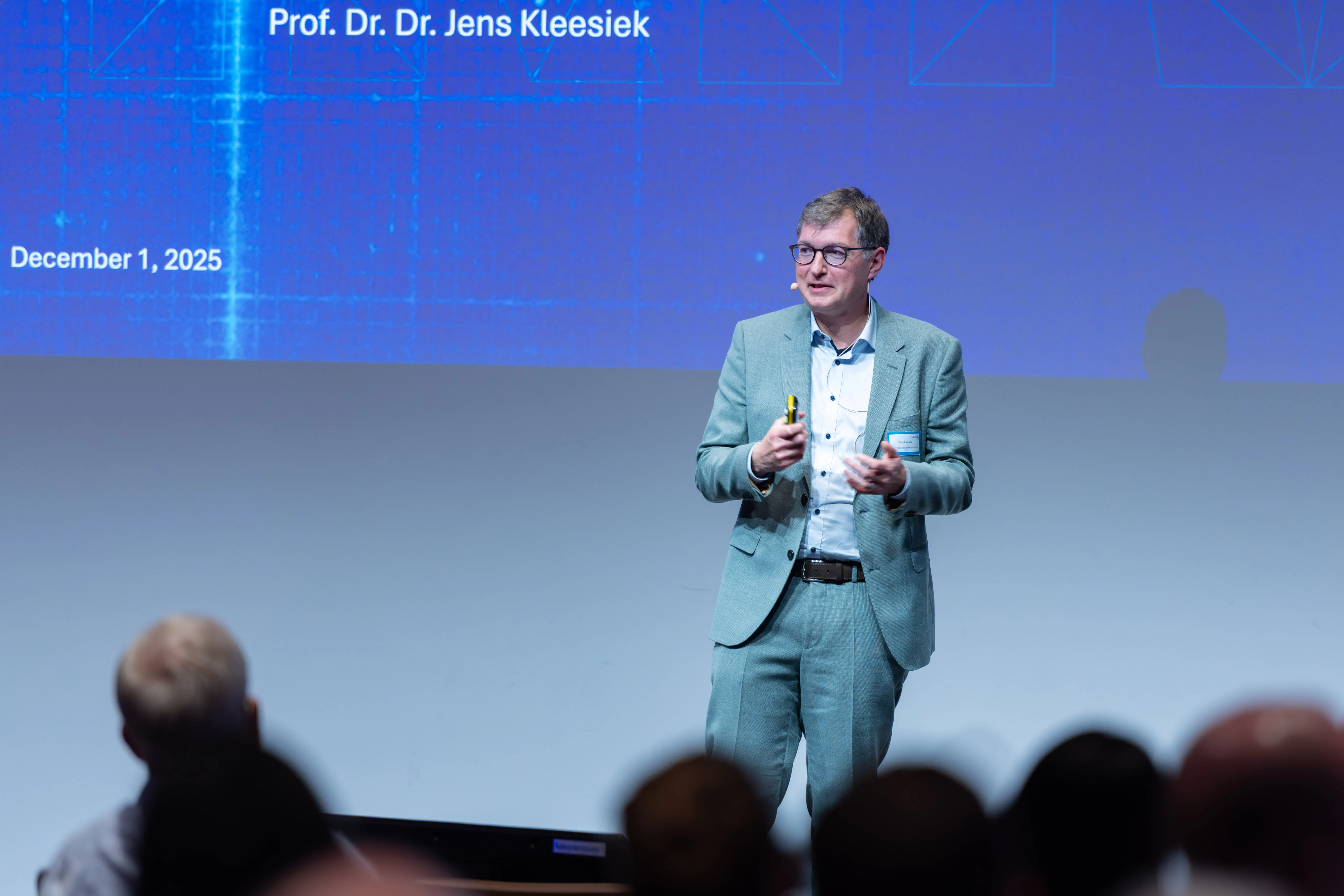
Prof. Dr. med. Jens Kleesiek delivered the keynote speech at The LOOP Zurich's 2025 annual event.
Jens Kleesiek is a professor of translational image-guided oncology and Director of the Institute for Artificial Intelligence in Medicine (IKIM) at University Medicine Essen. He develops AI methods that use a combination of imaging, laboratory values and clinical information to recognise patterns in medical data. The aim is to support doctors in making well-founded, data-based decisions in everyday clinical practice.
One patient, two systems, one decision
“Just imagine,” says Kleesiek, “that the tumour section of a 58-year-old patient is digitalised and displayed on the screen. Within seconds, the AI flags suspicious cell ranges, counts tumour cells and provides statistical evaluations.” Kleesiek goes on to explain that the pathologist reviews, validates and supplements the findings – a combination of human expertise and machine precision that speeds up the diagnostic process and directly benefits patients. The patterns learned from the image data serve as the basis for further prognoses. The AI does not just record the location of the tumour cells, but also how abundant they are. It also calculates relapse probabilities, risks of complications and possible therapeutic results.
Much still in the pilot phase
“Machine learning is finding its way into the world of medicine,” says Kleesiek. “It is changing the way we detect and treat illnesses.” Especially in the provision of cancer care, where many fields of medicine converge, artificial intelligence can support processes and also offer a reproducible and cost-effective solution.
Most AI projects are currently still in test or pilot phases, or are being implemented on the ground in a handful of clinics. “In clinics and research facilities, interest in AI is high, but there are also concerns surrounding reliability, precision and data protection,” says Kleesiek. He firmly believes that human beings and algorithms will soon work hand in hand and make decisions that would have been inconceivable just a few years ago.
Standards as a silent revolution
But what happens behind the scenes when artificial intelligence is used in clinical practice? “The fact that technical standards such as FHIR (Fast Healthcare Interoperability Resources) and DICOM (Digital Imaging and Communications in Medicine) are being used by an increasing number of manufacturers and hospitals demonstrates the importance of interoperability – in other words, the ability of different IT systems to exchange and share data in a uniform manner,” explains Kleesiek. Not everyone will be familiar with these acronyms: DICOM ensures that medical image data – such as MRI scans or digital tumour sections – can be saved and read in the same format everywhere, while FHIR regulates the structured transmission of these images together with other patient data such as laboratory values or findings.
This allows a pathologist in Berlin to access the same image and laboratory information as a colleague in Zurich – and AI can use this data to make reliable prognoses. “The standardised database facilitates the analysis, exchange and integration of multimodal data,” explains Kleesiek, who studied medicine and bioinformatics. “Without standards like these, the use of AI in hospitals would remain fragmented.”
Cloud platforms as an alternative to high-performance servers in basements
AI models need computing power – a lot of computing power. “If the local hardware does not suffice, hospitals can work with cloud solutions,” proposes Kleesiek. He and his team have developed an infrastructure that can be installed both locally and in the cloud.
The cloud offers clinics a host of tangible benefits in this regard: it allows them to flexibly scale computing power in line with their needs – for example, for training large models or evaluating extensive image data sets – without having to purchase and maintain their own high-performance servers. Investment costs for hardware are eliminated or converted into predictable operating costs. Cloud platforms also enable the rapid deployment of new applications, automatic updates and high reliability through redundant systems. Cross-site collaboration is also made easier: researchers and clinicians can securely access shared data and model environments, shortening development cycles and speeding up innovation.
But the cloud does not give users a free pass: health data is extremely sensitive and trust is the currency of digital medicine. Kleesiek’s approach combines pseudonymisation, access restrictions, regulatory compliance and the technical separation of training and application systems, demonstrating how innovation and data protection go hand in hand.
What will hospitals look like in 2035?
When asked about the hospital of the future, the physician paints the following picture: AI-supported systems will continuously monitor patients’ vital signs, while early warning algorithms will detect complications even before the first symptoms appear. Robots will ease the burden on nursing staff and medical decisions will be supported by real-time forecasts from AI models that combine image data, laboratory values and clinical information.
The doctor of the future will spend less time searching for data and more time interpreting it. Nurses will do less – and coordinate more. Kleesiek is convinced that AI will not dominate; it will simply be taken for granted. Provided, according to the researcher, that regulatory obstacles do not slow down progress.
About:
Professor Jens Kleesiek is the Chair of Translational Image-guided Oncology and Director of the Institute for Artificial Intelligence in Medicine (IKIM) at University Medicine Essen (UME). He studied medicine in Heidelberg and bioinformatics in Hamburg, where he earned a doctoral degree in informatics in 2012. After completing his education at Heidelberg University Hospital and the German Cancer Research Center (DKFZ), he obtained his specialist qualification in radiology, his habilitation and additional training in medical informatics.
Credits
Text: Marita Fuchs
Photo: Courtesy of The LOOP


